I can save a dozen photos of bangs and still struggle to say what makes one fringe different from the next. Is it the length, the thickness, or the way it parts? Knowing the names makes it much easier to find the look you want and explain it to your stylist.
Key Takeaways
- Curtain, side-swept, and long bangs are the easiest first fringe, because they blend into the rest of your hair as they grow.
- Your face shape guides length and width, but your hair texture and hairline decide how the fringe behaves day to day.
- Compare two or three styles on your own photo before you book. You’ll walk in with a name and a picture of yourself, not someone else.
Types of Bangs at a Glance
Many styles sound alike, so this table shows what sets each one apart and which style people most often confuse it with.
| Bangs type | Defining feature | Often confused with |
|---|---|---|
| Curtain | Center part, longer pieces that open toward the cheekbones | Bottleneck |
| Wispy | Thinned, feathered strands with uneven gaps | See-through |
| Blunt | One solid, straight line across the forehead | Birkin |
| Side-swept | Falls diagonally from a side part | Long bangs |
| Micro | Very short, well above the brows | Blunt |
| French | Thick, textured, brow to lash length, blends into the sides | Birkin |
| Birkin | Light, brow-skimming, with piecey ends | French |
| Bottleneck | Short and narrow in the center, longer toward the eyes | Curtain |
| See-through | A thin, even veil with the forehead visible | Wispy |
| Curly | Shaped around natural curls, coils, or waves | Choppy |
| Choppy | Point-cut, deliberately uneven ends | Wispy |
| Long | Past the brows, swept aside or parted | Curtain |
12 Different Types of Bangs, Compared
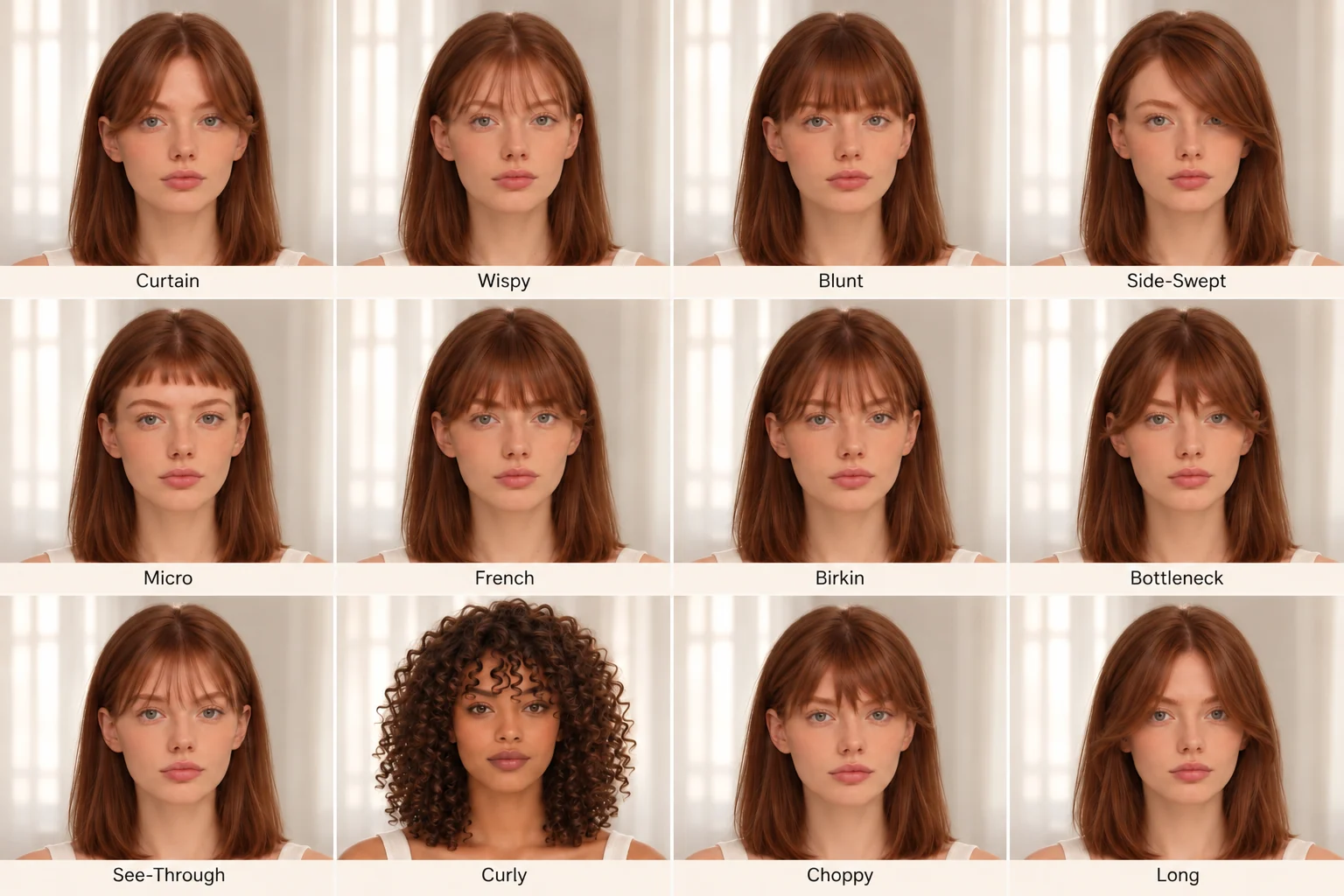
Every photo in this section uses the same woman and the same original photo, so the fringe is the only thing that changes. Curly bangs are the one exception, shown on a naturally curly model, since a curly fringe on straight hair would not look real. Each style comes with a ready-to-use “Try this look” prompt. Once you’ve found a few favorites, you can preview them on your own photo.
1. Curtain Bangs
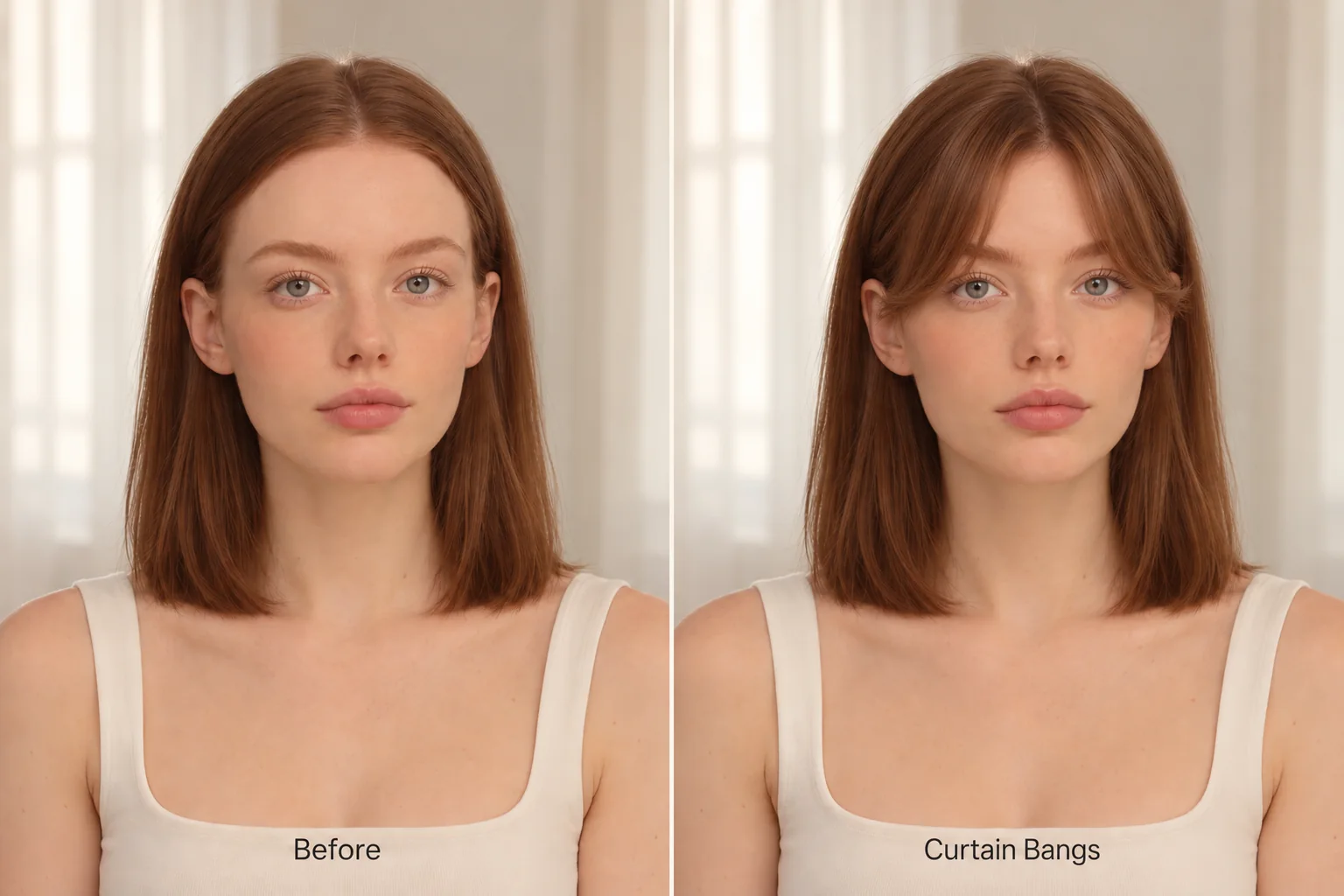
Curtain bangs part in the middle and sweep out toward the cheekbones. Unlike bottleneck bangs, the center opens wide enough to show a strip of forehead.
Best for: Round, square, and oval faces with straight or wavy hair of medium to thick density.
Upkeep: Low to medium.
Try this look: “Add cheekbone-length curtain bangs with a center part, shorter at the middle and opening toward my cheekbones. Match my hair color and change only the bangs.”
2. Wispy Bangs
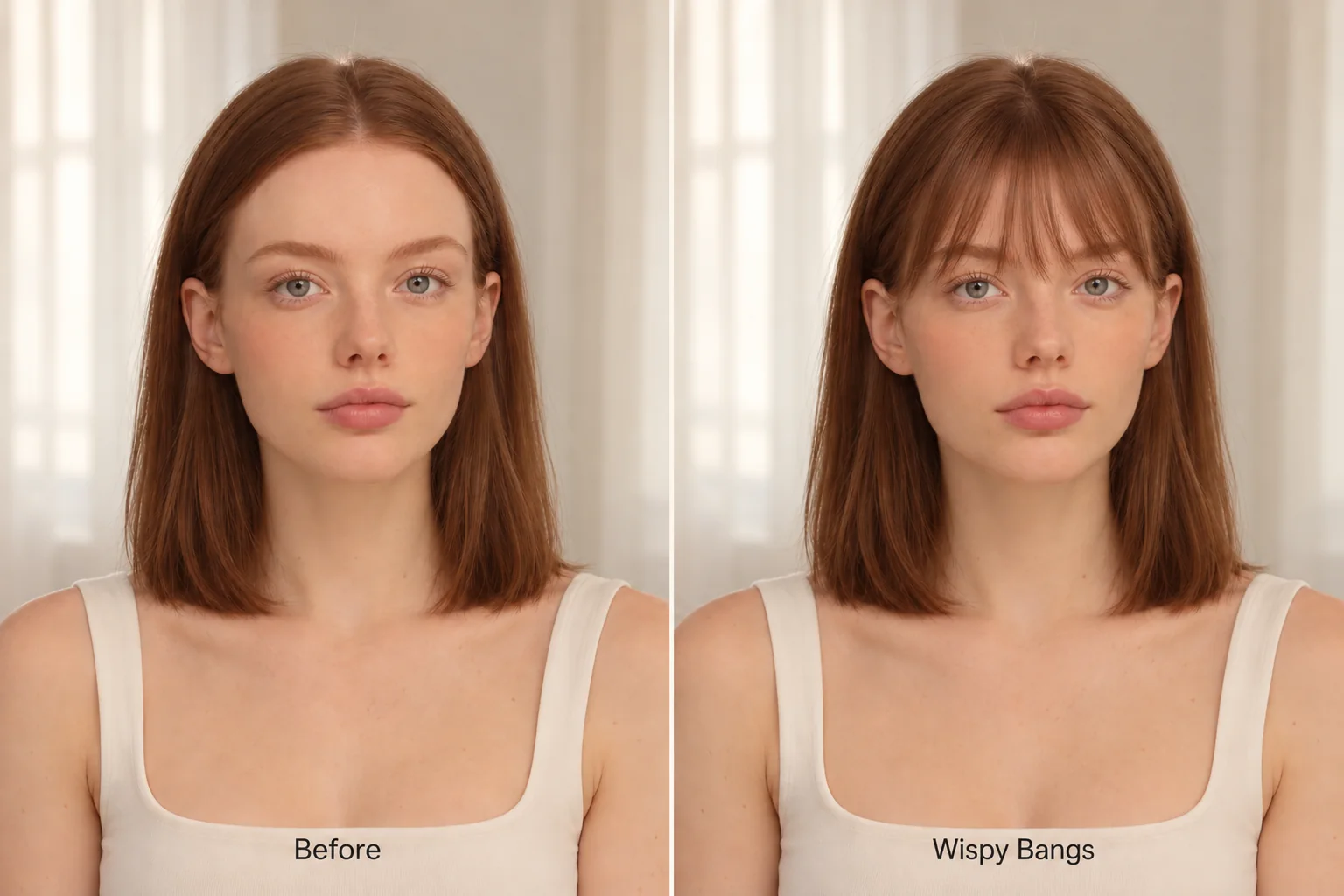
Wispy bangs are thinned and feathered, so the strands separate and let some forehead show. Unlike see-through bangs, the gaps fall unevenly for a softer, lived-in look.
Best for: Heart and oval faces with fine to medium hair.
Upkeep: Medium.
Try this look: “Add light wispy bangs with feathered, separated strands that sit just above my eyebrows. Keep my face, hair color, and the rest of my hair the same.”
3. Blunt Bangs
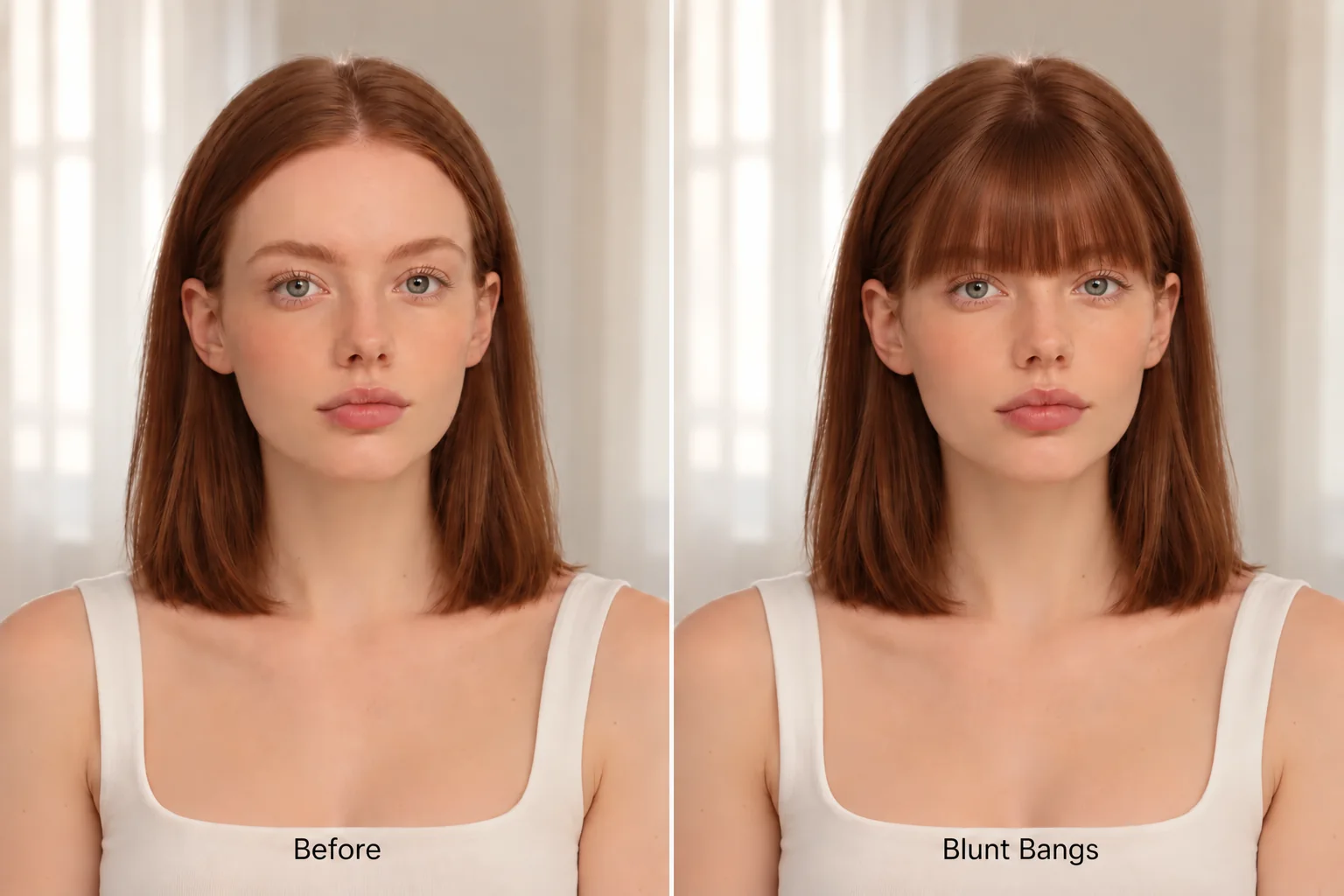
Blunt bangs form one solid, straight line across the forehead, usually at the brows, and unlike Birkin bangs, the edge is crisp rather than piecey.
Best for: Long and oval faces with straight, thick hair.
Upkeep: High.
Try this look: “Add full blunt bangs cut in one straight line at my eyebrows, dense and even across. Match my hair color and keep my face unchanged.”
4. Side-Swept Bangs
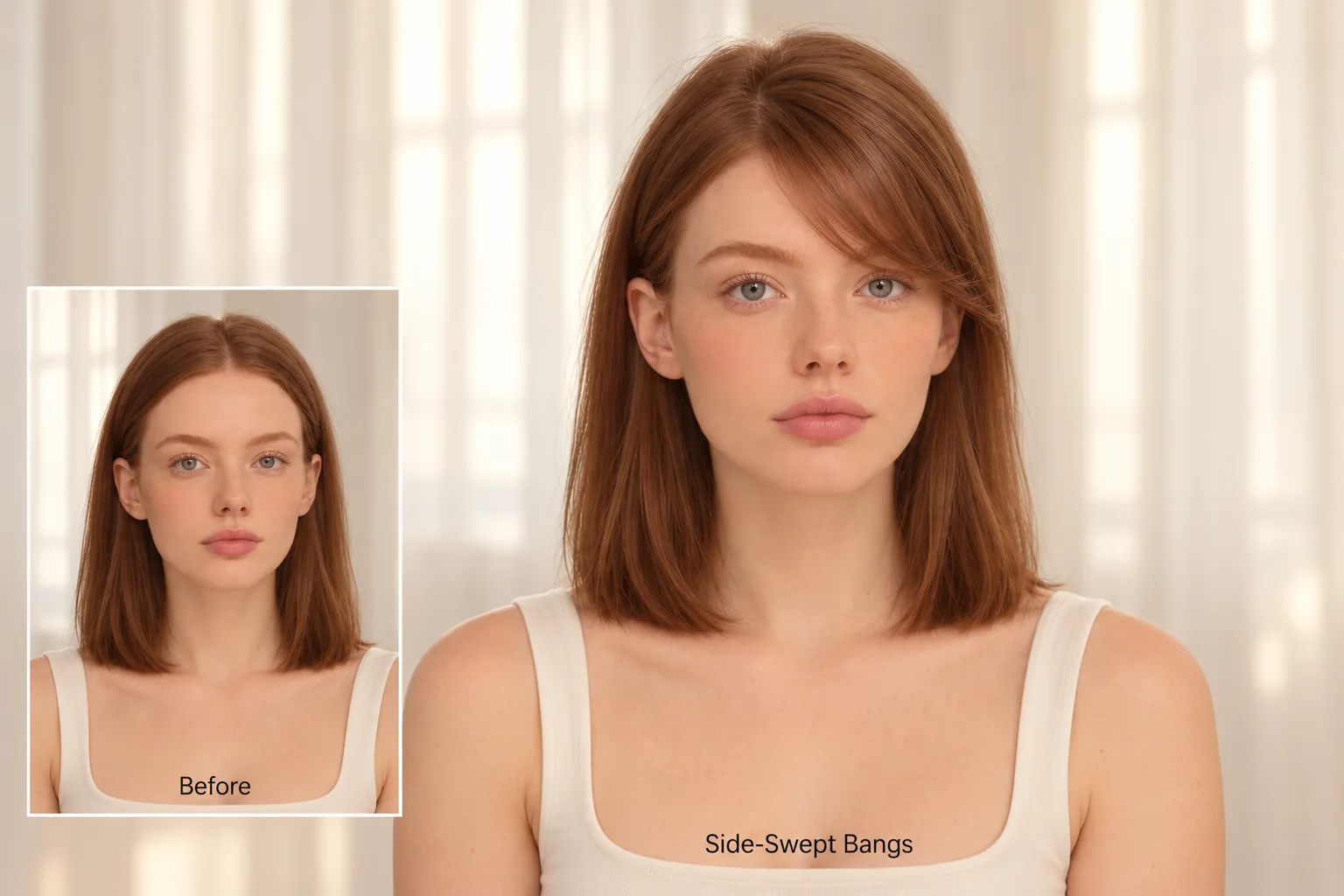
Side-swept bangs fall diagonally across the forehead from a side part, so one eye stays open while the other side gets a soft frame.
Best for: Round and square faces, and almost any hair texture.
Upkeep: Low.
Try this look: “Add long side-swept bangs from a deep side part, falling diagonally across my forehead to the opposite cheekbone. Change only the bangs.”
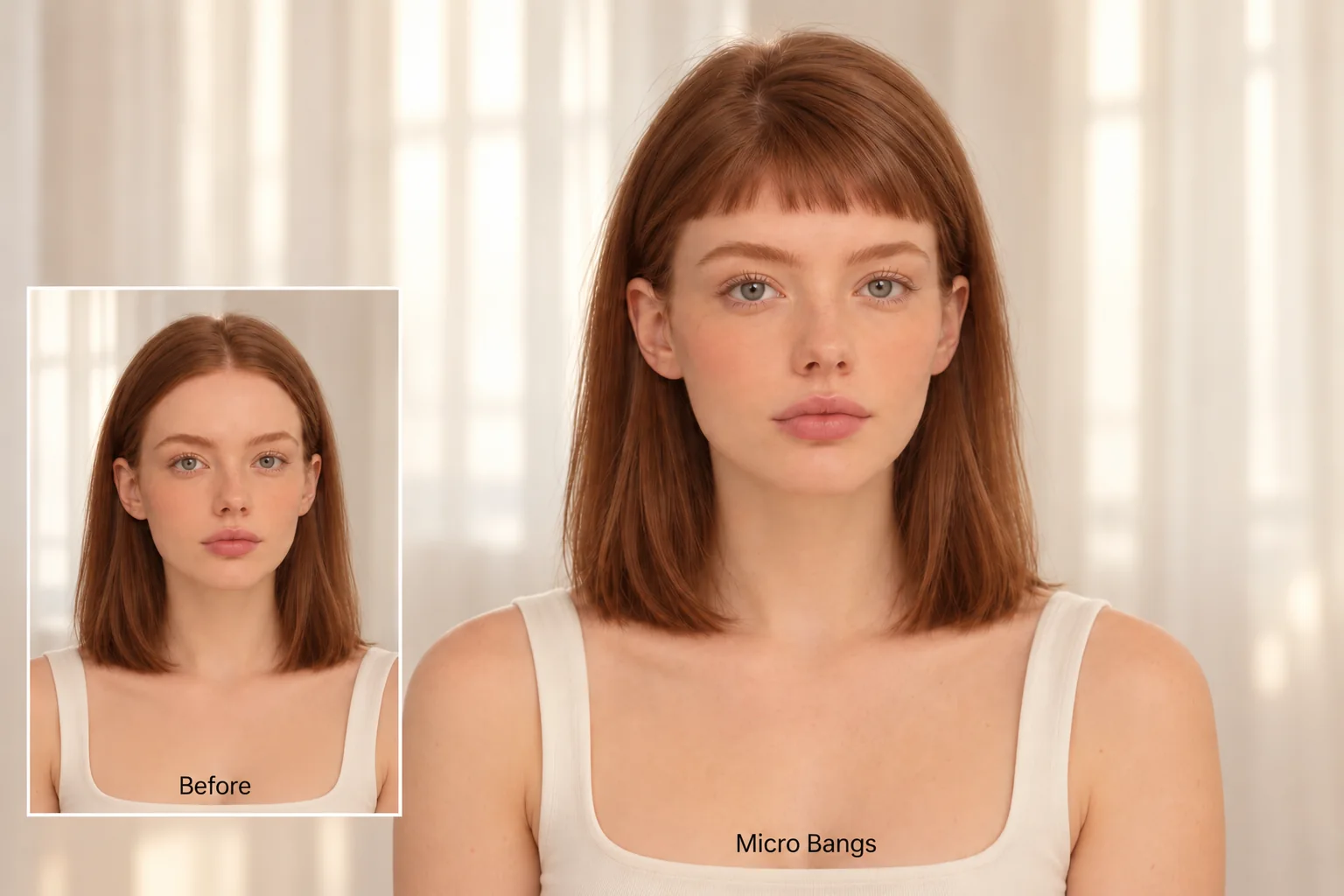
5. Micro Bangs
Micro bangs, also called baby bangs, sit well above the brows, often halfway up the forehead. That makes them the shortest and boldest fringe on this list. Unlike blunt bangs, they show your whole brow line and change the proportions of your face at a glance.
Best for: Oval and heart faces with straight hair and no strong cowlick at the hairline.
Upkeep: High. They need frequent trims to keep their shape and take the longest to grow out.
Try this look: “Add short micro bangs that end halfway up my forehead, straight and even, well above my eyebrows. Match my hair color and keep everything else the same.”
6. French Bangs
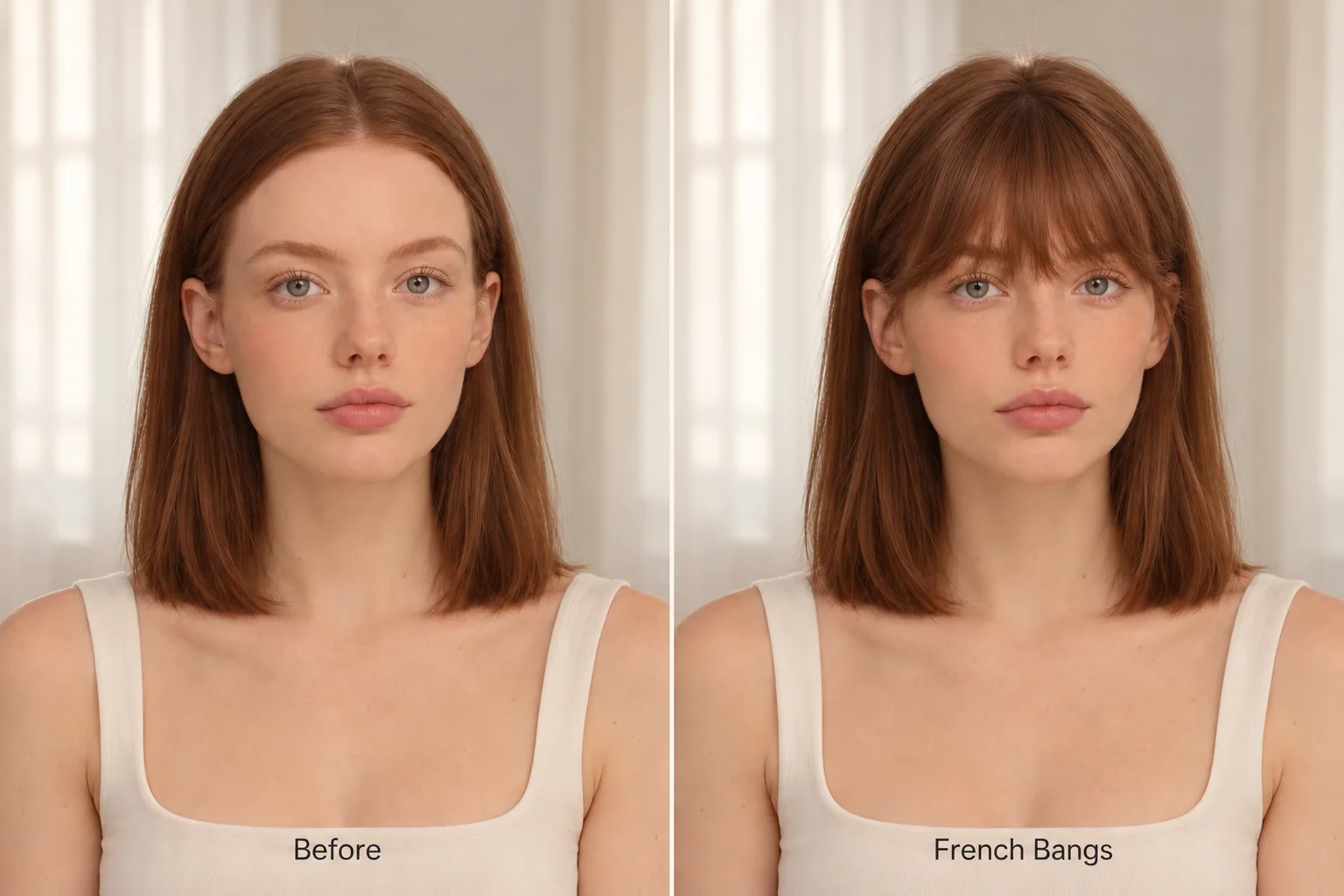
French bangs, often called French girl bangs, are a broad style with natural texture and a slightly messy finish. The edges blend into the hair at the sides. Birkin bangs are often considered one version of the look, so this guide shows French bangs fuller and Birkin bangs lighter to tell them apart.
Best for: Oval and long faces with medium to thick, straight or wavy hair.
Upkeep: Medium.
Try this look: “Add thick, textured French bangs that fall between my eyebrows and lashes and blend into the hair at the sides. Keep my face and hair color unchanged.”
7. Birkin Bangs
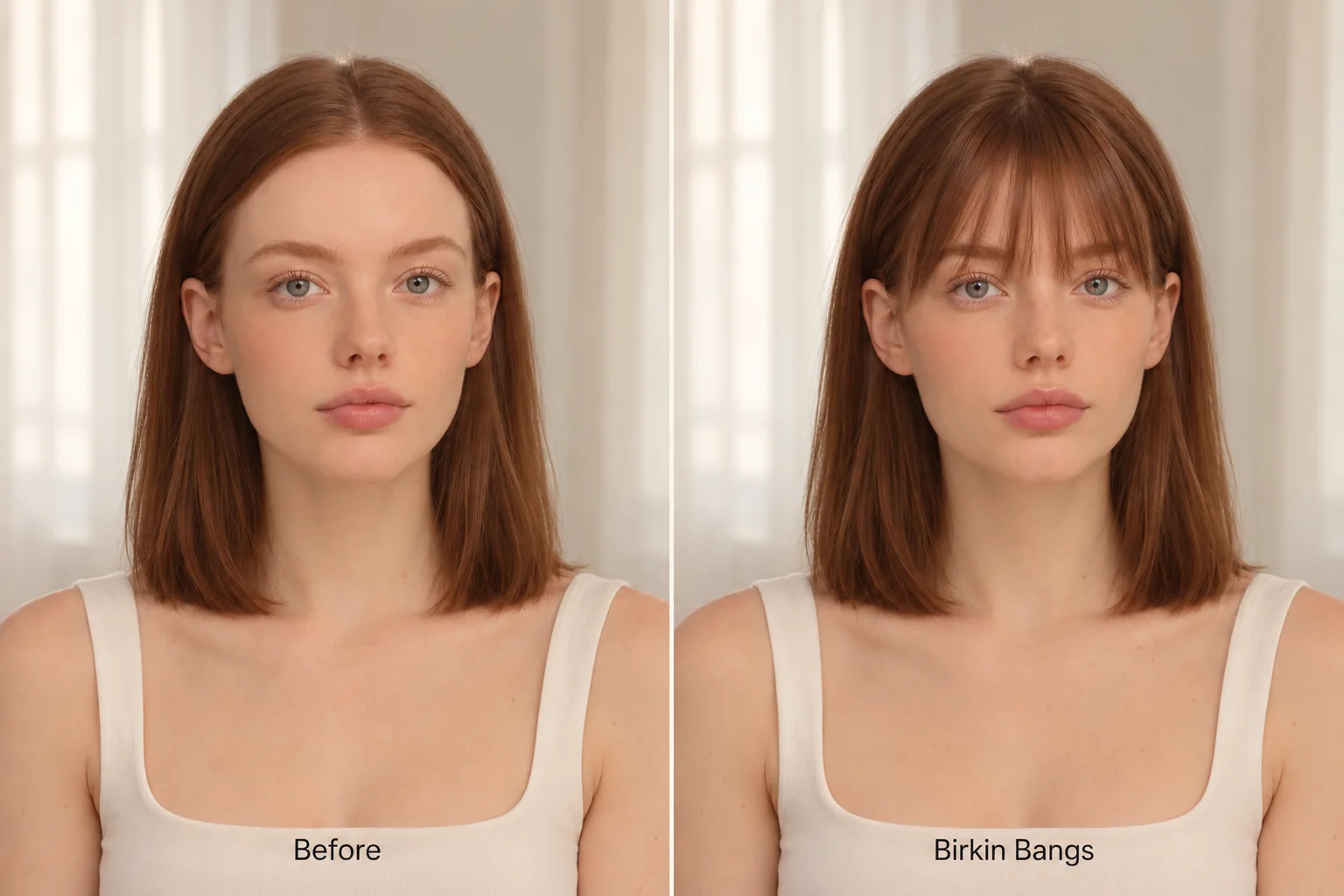
Birkin bangs are inspired by Jane Birkin’s 1960s fringe. They skim the brows and end in soft, slightly separated strands, airy enough to let the eyes take the focus.
Best for: Long, oval, and heart faces with straight or wavy hair.
Upkeep: Medium.
Try this look: “Add light Birkin bangs that skim my eyebrows, with soft, piecey ends and a slightly undone finish. Match my hair color and change only the bangs.”
8. Bottleneck Bangs
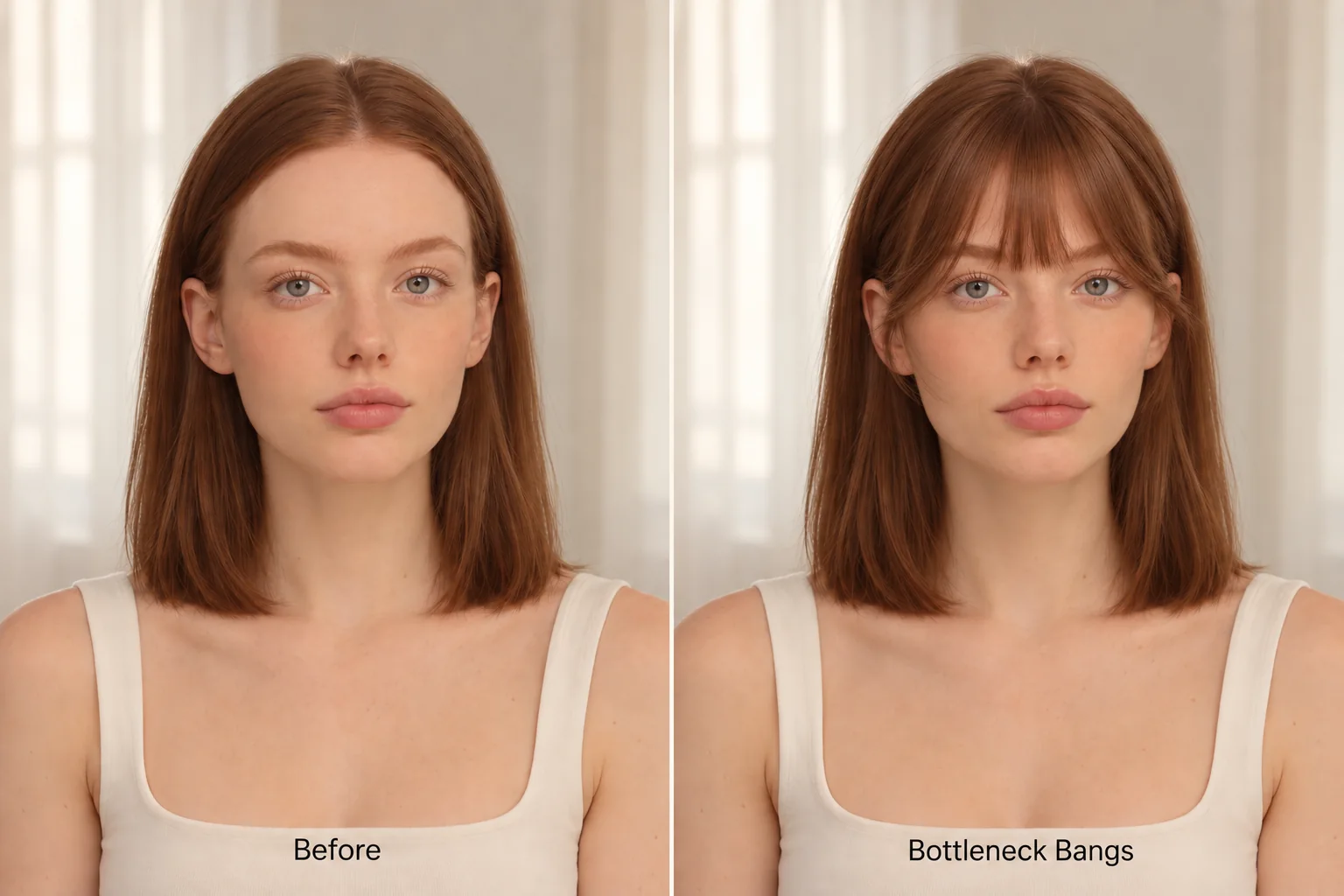
Bottleneck bangs are short and narrow in the center, like the neck of a bottle. They get longer as they reach the outer corners of the eyes and the cheekbones. Unlike curtain bangs, the center stays mostly closed, so they read as a full fringe from the front.
Best for: Heart and square faces with straight or wavy hair.
Upkeep: Medium.
Try this look: “Add bottleneck bangs, short and narrow at the center. Make them longer toward the outer corners of my eyes and my cheekbones. Keep my face and hair color the same.”
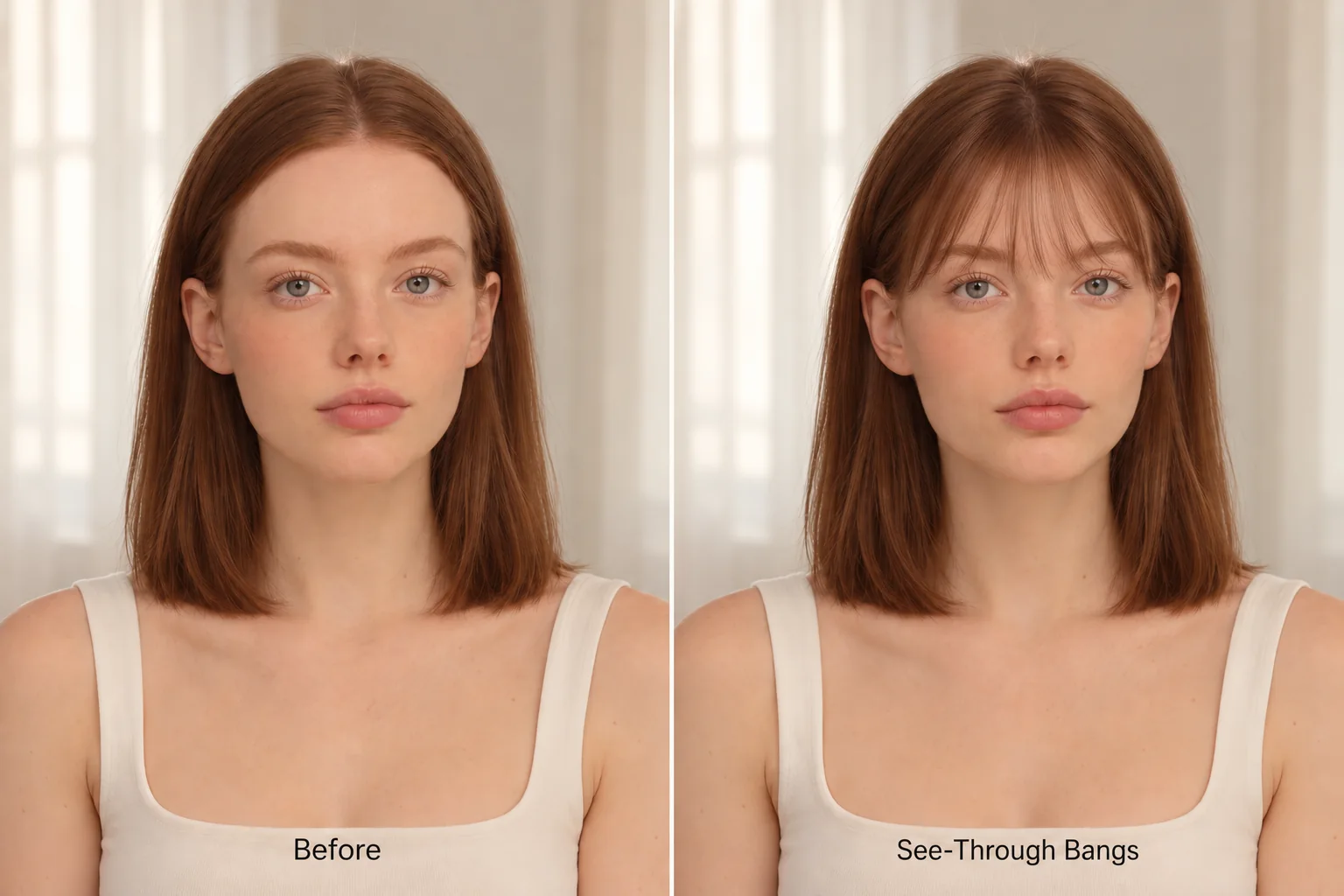
9. See-Through Bangs
See-through bangs are a thin, even veil of hair with the forehead clearly visible behind it, a style popular in Korean salons. Unlike wispy bangs, the strands are spaced evenly rather than piecey.
Best for: Round and oval faces with fine to medium, straight hair.
Upkeep: Medium. They usually need a quick round-brush curl to keep their shape.
Try this look: “Add thin, see-through bangs in an even, airy layer just above my eyebrows, with my forehead visible through them. Change only the bangs.”
10. Curly Bangs
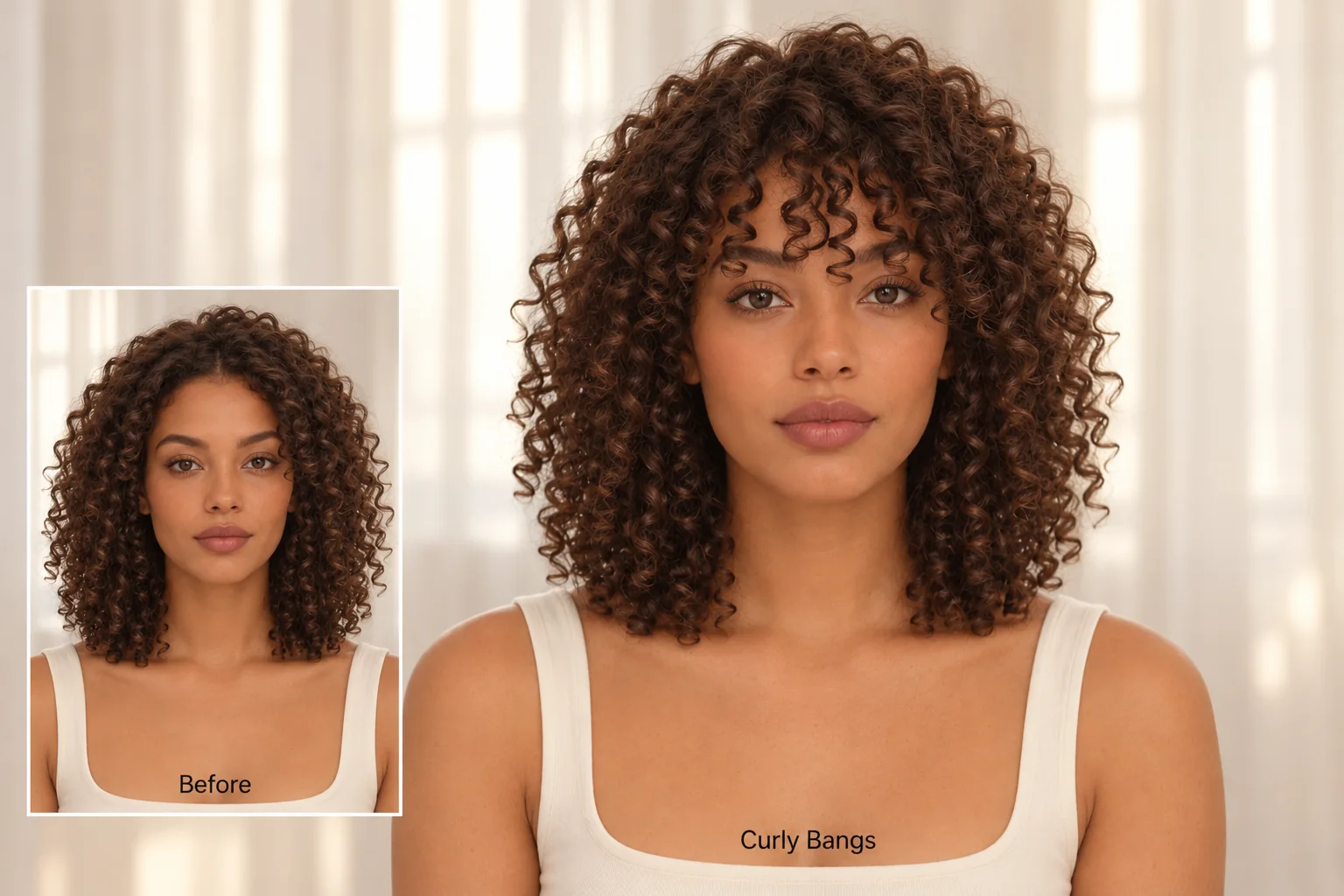
Curly bangs are shaped around your natural curls, coils, or waves. Each curl keeps its own shape instead of being flattened into a straight line.
Best for: Curly and coily hair on any face shape.
Upkeep: Medium.
Try this look: “Add curly bangs that match my natural curl pattern and hair color, ending at my eyebrows once the curls settle. Keep the rest of my hair and my face unchanged.”
11. Choppy Bangs
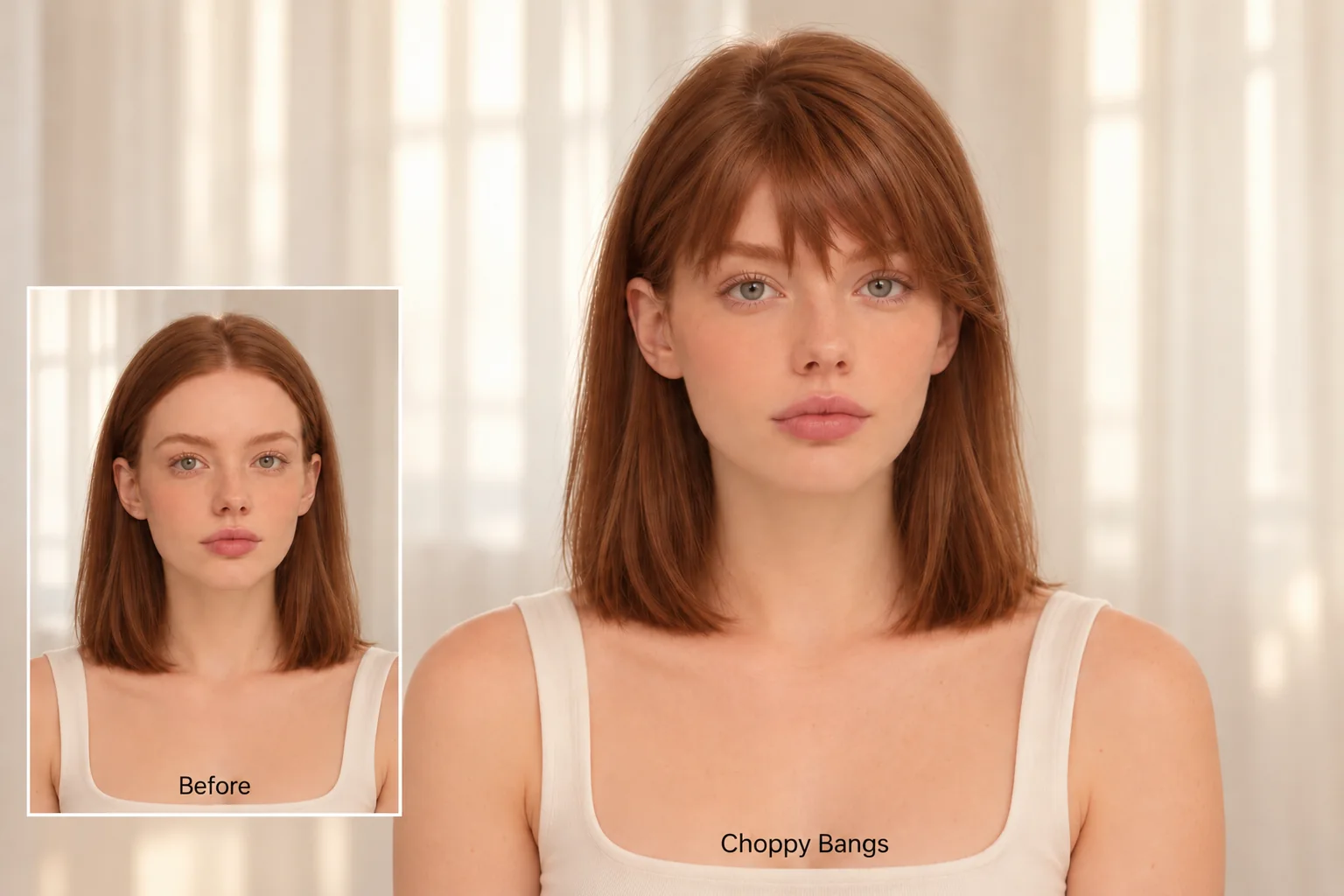
Choppy bangs are point-cut so the ends land at different lengths on purpose. Unlike wispy bangs, they keep plenty of weight, which makes them a natural match for shags and wolf cuts.
Best for: Square and oval faces with thick or wavy hair.
Upkeep: Medium. The messy finish hides a few weeks of growth.
Try this look: “Add choppy, point-cut bangs with uneven ends at brow length, textured and full. Match my hair color and keep my face the same.”
12. Long Bangs
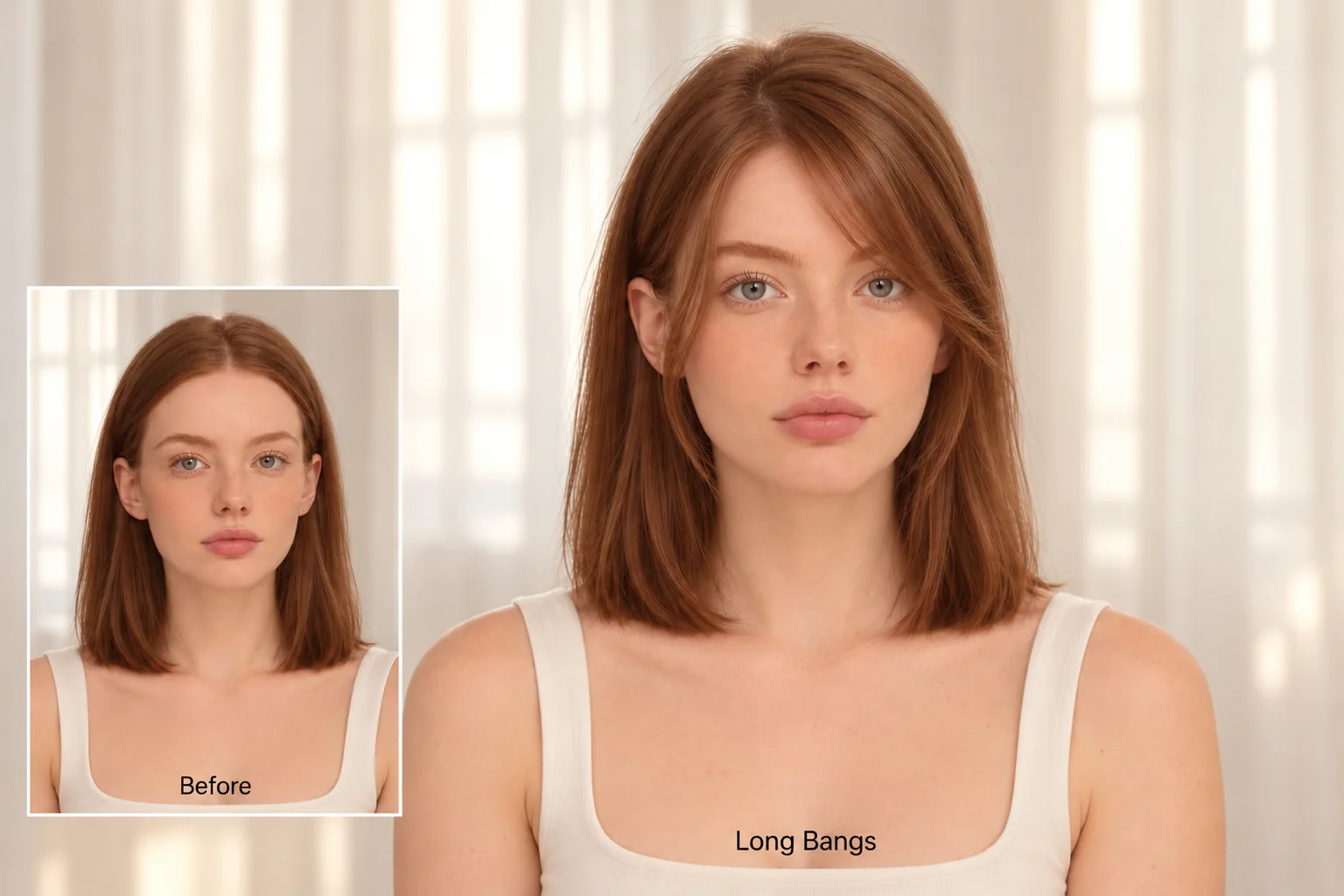
Long bangs extend past the eyebrows and can reach the cheekbones. They’re usually parted, swept aside, or blended into face-framing layers rather than worn over the eyes. Unlike curtain bangs, they don’t need a center part, which makes them the easiest way to test a fringe without a big commitment.
Best for: Long faces, high foreheads, and anyone getting bangs for the first time.
Upkeep: Low.
Try this look: “Add long bangs that reach my cheekbones, swept slightly to one side and blending into face-framing layers. Change only the bangs.”
Low-Maintenance Bangs: Upkeep at a Glance
Side-swept, long, and curtain bangs are the most low-maintenance bangs, because they grow into the rest of your hair instead of losing their shape. The table compares all 12 types of bangs on the four things that decide your real upkeep.
| Bangs type | Forehead coverage | Daily styling | Trims | Growing out |
|---|---|---|---|---|
| Curtain | Light to medium | Low to medium | Less frequent | Easy |
| Wispy | Light | Low to medium | Regular | Moderate |
| Blunt | Full | Medium to high | Frequent | Hard |
| Side-swept | Partial | Low | Less frequent | Easy |
| Micro | Minimal | Medium to high | Frequent | Hardest |
| French | Full | Medium | Regular | Moderate |
| Birkin | Medium | Medium | Regular | Moderate |
| Bottleneck | Medium | Medium | Regular | Easy |
| See-through | Light | Medium | Regular | Moderate |
| Curly | Medium | Low to medium | Regular | Moderate |
| Choppy | Medium | Low | Regular | Moderate |
| Long | Partial | Low | Less frequent | Easy |
Your own hair can move a style up or down this table. A cowlick, very fine hair, or a humid climate can turn a medium-upkeep fringe into a daily project. If you’re still deciding whether bangs fit your routine at all, the should I get bangs guide walks through the questions to ask first.
Best Bangs for Your Face Shape and Forehead
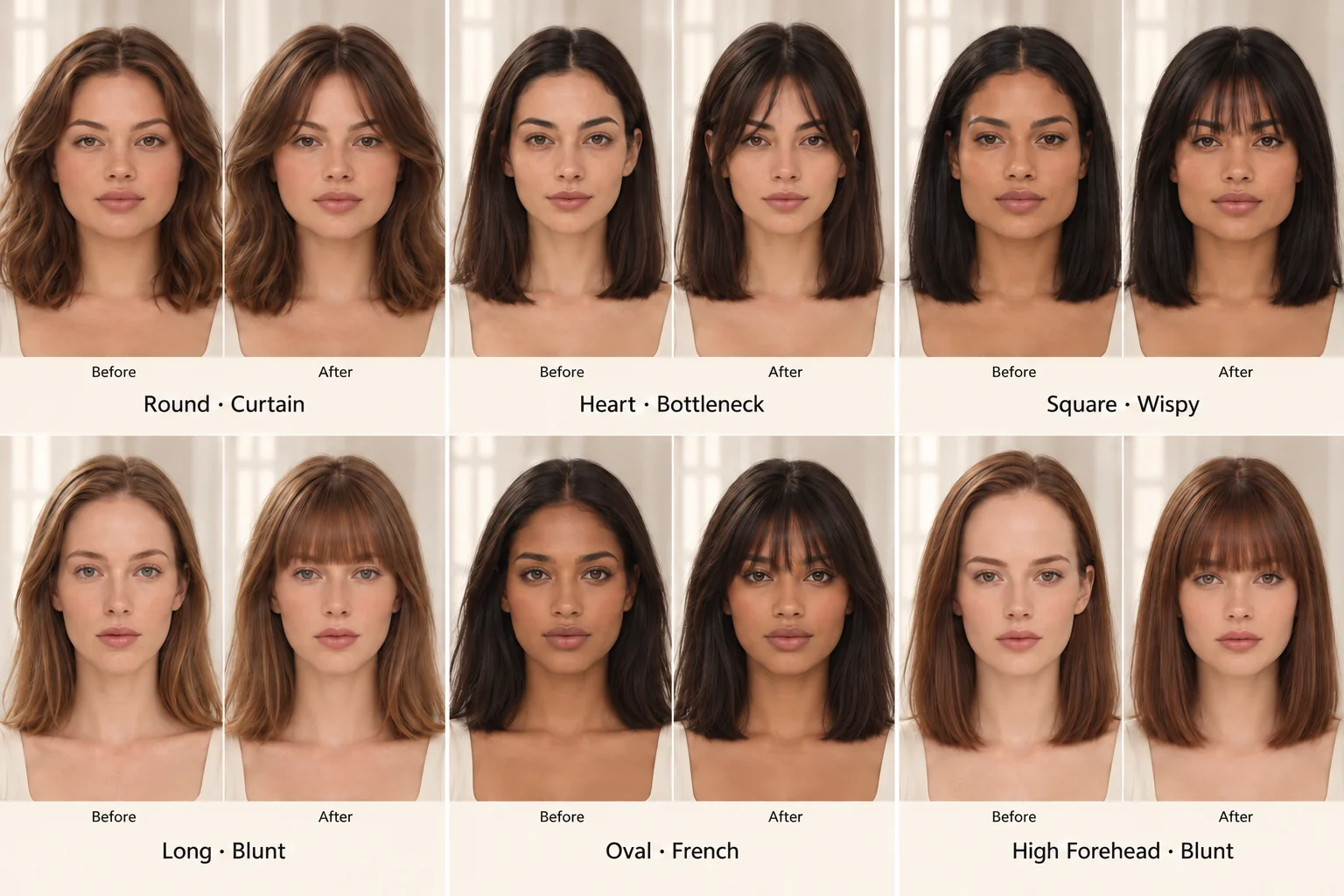
Face shape is a starting point, not a rule. Use it to pick two styles to compare first, then adjust the length, width, and thickness to suit your features.
Bangs for a Round Face
Compare curtain bangs and side-swept bangs first. Keep the sides longer than the cheekbones and try an off-center part, since a little length past the cheeks makes a round face look longer.
Bangs for a Heart-Shaped Face
Compare wispy bangs and bottleneck bangs first. Both soften a wider forehead, and the longer outer pieces of a bottleneck fringe add width near the cheekbones where a heart-shaped face narrows.
Bangs for a Square Face
Compare wispy bangs and soft curtain bangs first. Ask for textured, uneven ends so the fringe doesn’t repeat the strong line of your jaw.
Bangs for a Long Face
Compare blunt bangs and Birkin bangs first. A fringe that reaches the brows and covers most of the forehead makes a long face look shorter. Adjust the width so it runs close to the temples.
Bangs for an Oval Face
Compare curtain bangs and French bangs first. An oval face can carry most types of bangs, so choose by your hair texture and how much time you’ll spend styling.
Bangs for a Big Forehead
Compare blunt bangs and curtain bangs first. Blunt bangs cover the most forehead, while curtain bangs cover less but are easier to grow out, so decide how much coverage you actually want.
Best Bangs for Thin, Thick, and Curly Hair
Your hair texture decides how a fringe behaves after you leave the salon, so check it against your face-shape picks.
Bangs for Thin Hair
Wispy, see-through, and side-swept bangs are good styles to compare if your hair is thin (lower density) or fine (thin strands). A full blunt fringe takes a lot of hair from the front of your head, which can leave the hair behind it looking sparse. If you love the blunt look, ask for a narrower fringe that doesn’t reach all the way to the temples.
Bangs for Thick Hair
Blunt, French, and choppy bangs suit thick hair, because they have enough density to hold a strong shape. Ask your stylist to remove a little weight from inside the fringe so it lies flat instead of puffing out.
Bangs for Curly Hair
Curly bangs and curtain bangs cut on curls work best on curly and coily hair. Ask for the fringe to be cut dry and a little longer than your goal length.
See Which Types of Bangs Suit You on Your Own Photo
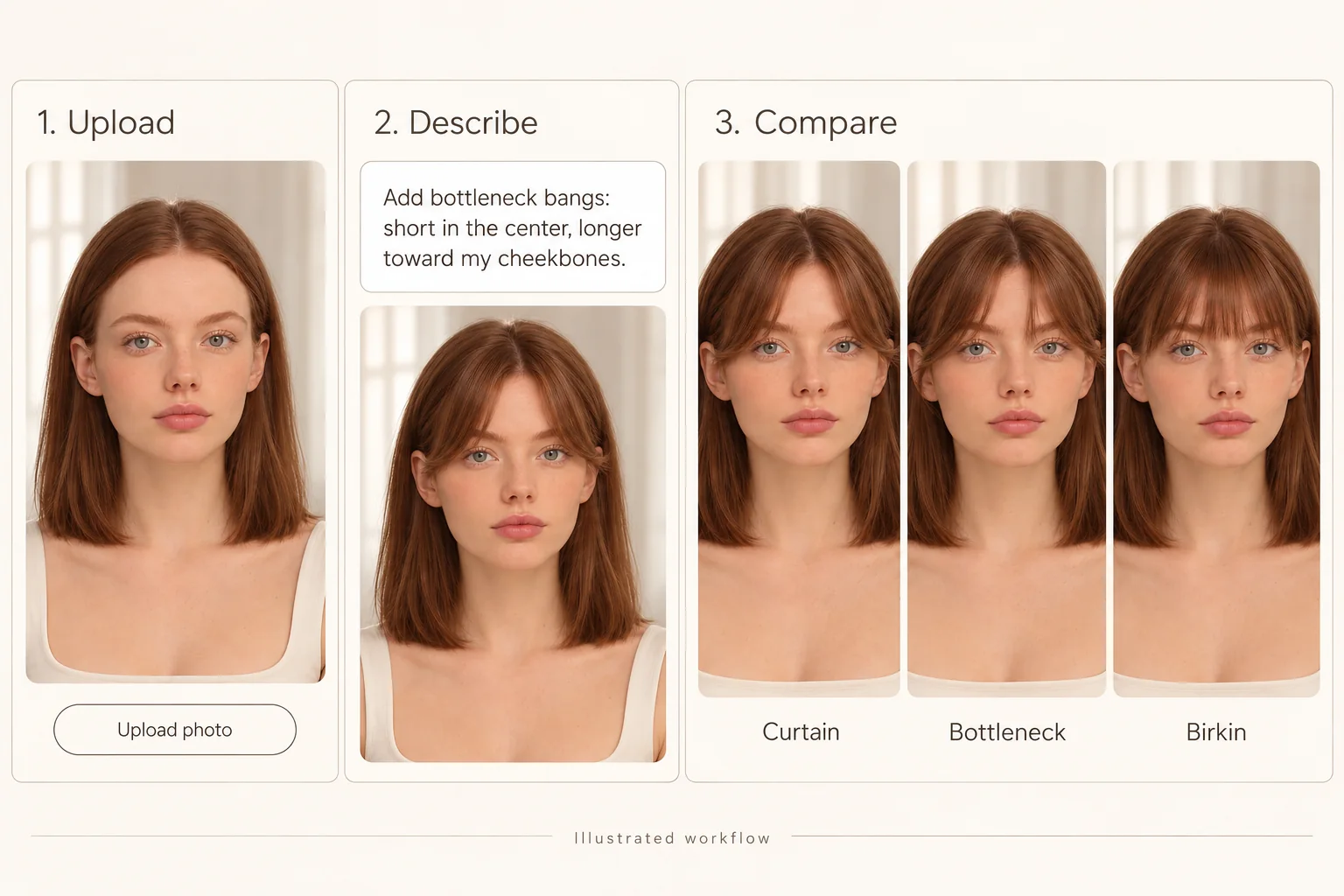
Reading about 12 types of bangs is one thing, but seeing two or three on your own face settles the choice much faster. Once you’ve picked your favorites, open PhotoGrid’s AI hairstyle changer and line them up in three steps.
Step 1: Upload a clear selfie. Use a front-facing photo in natural light with your hairline and forehead visible.
Step 2: Pick two or three styles from this list. Click a bangs preset, or paste the “Try this look” prompt to set the exact length and thickness.
Step 3: Put them side by side. Compare each fringe against your original photo and save the one you’d book.
Types of Bangs FAQ
What are the most popular types of bangs right now?
Curtain bangs and Birkin bangs are two of the most popular types of bangs heading into 2027. Both are soft enough to grow out gracefully, and both show up across this year’s runway and street-style looks. You can see how they fit into the season’s cuts in the trending haircuts roundup.
What’s the difference between curtain bangs and wispy bangs?
The difference is the part and the spread. Curtain bangs split at the center and sweep toward the cheekbones, while wispy bangs fall straight down as a light, feathered fringe across the forehead. Curtain bangs are the easier one to grow out, and wispy bangs give more forehead coverage.
Are micro bangs hard to grow out?
Micro bangs are the hardest bangs on this list to grow out, because they start so far above the brows. Expect an awkward in-between stage before they reach a length you can sweep aside. Pinning them back or wearing a headband helps while they catch up with the rest of your hair.
What’s the difference between French bangs and Birkin bangs?
French bangs are thicker and more textured, and they blend into the hair at the sides. Birkin bangs are lighter, skim the brows, and end in soft, piecey strands. Choose French bangs for a fuller, polished frame, and Birkin bangs for a lighter, undone look.
Which types of bangs work with a cowlick?
Side-swept, curtain, and long bangs work best with a cowlick, because they can follow the direction your hair already grows. Short styles like micro and blunt bangs have less weight to hold them down, so a cowlick is more likely to flip them up. Show your stylist where the cowlick sits, and ask for the fringe to be cut a little longer and heavier over it.
Find Your Bangs Before You Cut
Now that you know what each fringe is called, the hard part is picking yours. Line up your top two or three on your own selfie. Then walk into the salon with the name and a picture of you wearing it.